<?xml version="1.0" encoding="utf-8"?><feed xmlns="http://www.w3.org/2005/Atom" ><generator uri="https://jekyllrb.com/" version="3.9.5">Jekyll</generator><link href="https://meganlavengood.github.io/feed.xml" rel="self" type="application/atom+xml" /><link href="https://meganlavengood.github.io/" rel="alternate" type="text/html" /><updated>2024-04-24T15:06:33+00:00</updated><id>https://meganlavengood.github.io/feed.xml</id><title type="html">Analysis of Timbre</title><subtitle>Course website for MUSI 710. Spring 2024.</subtitle><author><name>Megan Lavengood</name></author><entry><title type="html">Final Project</title><link href="https://meganlavengood.github.io/2024/final-project.html" rel="alternate" type="text/html" title="Final Project" /><published>2024-04-16T15:10:11+00:00</published><updated>2024-04-16T15:10:11+00:00</updated><id>https://meganlavengood.github.io/2024/final-project</id><content type="html" xml:base="https://meganlavengood.github.io/2024/final-project.html"><![CDATA[<p>Your final project is an analysis of timbre/orchestration in a piece of your choosing. The purpose of the project is for you to apply the skills you’ve learned in class to something that you enjoy and want to share with the rest of the class.</p>

<table>
  <thead>
    <tr>
      <th>Due date (end-of-day)</th>
      <th>Assignment</th>
    </tr>
  </thead>
  <tbody>
    <tr>
      <td>Fri, Apr 12</td>
      <td><a href="#project-worksheet">Project worksheet</a></td>
    </tr>
    <tr>
      <td>Fri, Apr 19</td>
      <td><a href="#video">Video</a></td>
    </tr>
    <tr>
      <td>Tue, Apr 23</td>
      <td><a href="#peer-review">Peer review</a></td>
    </tr>
    <tr>
      <td>Apr 29–May 6</td>
      <td><a href="#essay">Essay</a></td>
    </tr>
  </tbody>
</table>

<h2 id="recommended-reading">Recommended reading</h2>

<p>If you want more explicit help and guidance on writing an analytical paper, read Chapter 7 of Rogers, Bottge &amp; Haefeli 2020. This is available for you in the Readings folder on Teams. This chapter will teach you how to make sure your paper is unified and has a coherent argument.</p>

<hr />

<h2 id="project-worksheet">Project Worksheet</h2>

<p>To get you started, I have designed a worksheet that helps you think through your project. I have added a copy of the worksheet to your homework submit folder. The filename is <code class="language-plaintext highlighter-rouge">13 final project worksheet.docx</code>.</p>

<p>Save as a PDF and upload to your <strong>homework submit</strong> folder by <strong>Fri, Apr 12.</strong></p>

<hr />

<h2 id="video">Video</h2>

<p>Make a video (<strong>max 10 minutes</strong>) in which you apply knowledge you gained in our seminar to a song of your choosing. It is worth 15% of your final grade.</p>

<p>The video will be like a first draft of your final paper. This will be an opportunity for you to get feedback from me and your peers.</p>

<h3 id="content">Content</h3>

<ul>
  <li>Use the worksheet you submitted and my feedback as a guide for your content. However, your video should go deeper than your worksheet. You should have specific analysis by this point.</li>
  <li>Analysis must engage with one or more methodologies discussed in class. This is where the majority of the points are—failure to do this will certainly result in a poor grade.</li>
  <li>You should have a clear thesis statement in your video, and all your analysis should tie into the thesis statement.</li>
  <li>Your video should be, at most, 10 minutes long. This correlates to about five double-spaced pages of writing. It’s really not much so make sure you’re tightly organized. I suggest taking on only one of your three examples/facts (referenced in the prep worksheet).</li>
  <li>Please make sure I have access to all necessary material to understand your paper (files or links for relevant video/audio, transcriptions, etc.).</li>
  <li>You should have a powerpoint presentation or some other comparable visuals.</li>
  <li><strong>This video is too short to include historical context—get straight to your analysis!</strong> Historical context will not help your grade and will only give you less space to present.</li>
</ul>

<h3 id="style">Style</h3>

<ul>
  <li>Your voice explaining everything must be included in the video.</li>
  <li>You may do either a picture-in-picture layout, where one picture is yourself talking to the camera and the other is your powerpoint, or you may do a disembodied voice layout with only your powerpoint on screen.</li>
  <li>Videos must be professional, rehearsed, well-organized, and polished, in order to maximize the effectiveness of your limited time.</li>
  <li>Videos should be edited to remove any awkward pauses and unnecessary content.</li>
</ul>

<h3 id="submission">Submission</h3>

<ul>
  <li>Upload your video on Teams by <strong>Fri, Apr 19</strong>.</li>
  <li>In the General channel, there is a folder called <strong>final project videos</strong>—this is where you should put your video.</li>
  <li>The filename of your video should be your last name.</li>
</ul>

<h3 id="video-grading-rubric">Video grading rubric</h3>

<table id="video-rubric" class="two-header-columns">
<thead>
<tr class="row-1 odd">
	<th class="column-1"></th><th class="column-2"></th><th class="column-3">proficient</th><th class="column-4">basic</th><th class="column-5">poor</th>
</tr>
</thead>
<tbody class="row-hover">
<tr class="row-2 even">
	<td rowspan="4" class="column-1">Analysis (60 points total)</td><td class="column-2">Thesis statement (10)</td><td class="column-3">Clearly presented, well-formed, interesting. (10)</td><td class="column-4">Clearly presented, well-formed, but not interesting. (7)</td><td class="column-5">Unclear thesis statement or poor thesis statement. (5)</td>
</tr>
<tr class="row-3 odd">
	<td class="column-2">Examples<br />
(10)</td><td class="column-3">1 or more specific example, analyzed in detail. (10)</td><td class="column-4">1 specific example, but superficial analysis. (5)</td><td class="column-5">No specific examples. (0)</td>
</tr>
<tr class="row-4 even">
	<td class="column-2">Methodology (30)</td><td class="column-3">Analysis relies on and deeply engages with a methodology learned in the course. (30)</td><td class="column-4">Methodology is clearly referenced but is not executed properly, or could use a more in-depth treatment. (20)</td><td class="column-5">Methodology is&nbsp; mentioned but not really used. (10)</td>
</tr>
<tr class="row-5 odd">
	<td class="column-2">Support<br />
(10)</td><td class="column-3">Analysis supports thesis statement. (10)</td><td class="column-4">Relationship between analysis and thesis statement is implied but not made clear enough. (7)</td><td class="column-5">Relationship btw. analysis and thesis statement is often unclear. (3)</td>
</tr>
<tr class="row-6 even">
	<td rowspan="3" class="column-1">Style&nbsp;<br />
(40 points total)</td><td class="column-2">Visuals (15)</td><td class="column-3">Visuals are professional, well organized, useful, and easy to follow. (15)</td><td class="column-4">Visuals are somewhat helpful but need more clarity or more polishing. (12)</td><td class="column-5">Visuals are difficult to follow and unpolished. (7)</td>
</tr>
<tr class="row-7 odd">
	<td class="column-2">Speaking (10)</td><td class="column-3">Presentation is rehearsed, voice is clear. No long pauses (&gt;4 sec.). Unneccessary or unneeded parts of the video have been edited/removed. (10)</td><td class="column-4">Could use more rehearsal, as evident from stumbling over words or long pauses, but overall the point is communicated. (7)</td><td class="column-5">Seems unprepared or improvised, language and points are unclear. The video has long pauses and unnecessary content. (3)</td>
</tr>
<tr class="row-8 even">
	<td class="column-2">Organization (15)</td><td class="column-3">Clear flow to the video. Easy for the audience to remember your main points. Time used efficiently. (15)</td><td class="column-4">Flow and main points can be discerned but the audience must work to find them. Time used efficiently. (12)</td><td class="column-5">Video is poorly sequenced and main points are lost. Video is too short or too long. (7)</td>
</tr>
</tbody>
</table>

<h2 id="peer-review">Peer review</h2>

<p>The peer review process is intended to mimic the process of reviewing an article for a journal. In addition to this practical experience, the review process should help you learn to pinpoint similar issues in your own work, and will allow you to get feedback from multiple perspectives (not just mine).</p>

<p>Peer review assignments will be posted to the General channel on Teams in a spreadsheet titled <code class="language-plaintext highlighter-rouge">Peer Review Assignments.xlsx</code>. Each student will be given two other students to review.</p>

<h3 id="content-1">Content</h3>

<p>You will complete an evaluation using a form; this form will be made accessible as a tab in the General channel. The form asks you to answer the following questions:</p>

<ol>
  <li>In your own words, and without re-watching the video, do your best to summarize the main points of the video. <em>This will do two things: 1) help the author identify any discrepancies between what they thought they were saying, and what they seem like they are actually saying, and 2) help the author understand where you are coming from with your following comments.</em></li>
  <li>What was the most effective part of this video’s analysis? In other words, where did the analysis make you hear something differently, understand the piece better, or convince you of the argument?</li>
  <li>Everything in your video and in your final project should relate clearly back to the thesis statement. Was there any point at which you weren’t sure why the information was being presented?</li>
  <li>The final paper is longer than the script for these videos will be. In light of that, name one or two areas where you think the author can slow down, explain more, or go more in depth, to make the paper longer and more effective.</li>
  <li>Pose one analytical question to the author, and explain how you would suggest answering that question. The author may think this is a good idea/question, and end up answering it when expanding their analysis for the final paper!</li>
</ol>

<p>Please don’t hesitate to provide honest feedback. <strong>Your feedback will not impact the scores that I give to the video.</strong> Of course, you ought to still be polite and constructive whenever possible.</p>

<h3 id="submission-1">Submission</h3>

<p>Complete the form on Teams by <strong>Tue, Apr 23</strong>.</p>

<h3 id="grading">Grading</h3>

<p>Your feedback will be graded on completion and counted as a homework grade.</p>

<hr />

<h2 id="essay">Essay</h2>

<p>The analytical essay is the capstone project of the course, and is worth 35% of your final grade. The purpose is to demonstrate what you learned in our seminar by performing your own creative analysis of a song of your choosing. The paper will be an expanded (at least twice as long) and refined version of your presentation.</p>

<h3 id="content-2">Content</h3>

<p>This is a music analysis paper. Some additional requirements and guidelines:</p>

<ul>
  <li>Your music analysis must <strong>rely on and deeply engage with</strong> the analytical approaches we learned in class. This is the most important aspect of this paper, and therefore worth the most points in the rubric.</li>
  <li>Your paper should be bound together with a thesis statement of some kind, i.e., some kind of central feature that you discovered while analyzing the piece through your chosen methodology.</li>
  <li>This is not a research paper; it is an analysis paper. Therefore, <em>if historical/cultural context directly enhances your central music-analytical thesis</em>, then you may include it. Otherwise, it is not necessary in this paper. It does not help your grade in any way—it’s just extra. And, if it’s copied/paraphrased unattributed from Wikipedia or some other source (i.e., plagiarized), it can actually <em>hurt</em> your paper. So just skip it.</li>
  <li>You should have chosen at least three aspects of the piece to focus on as examples which prove your thesis statement.</li>
  <li>Avoid qualitative language and irrelevant personal experience. The purpose of this paper is to show your understanding of the piece and the analytical techniques used, not to convince someone else to like the piece.</li>
  <li>Your tone and focus should be extremely similar to the readings we did throughout class.</li>
</ul>

<h3 id="length">Length</h3>

<ul>
  <li>Your paper should be at least 10 pages, but no more than 20.</li>
  <li>If you are under or over my suggested page counts, please send me a draft and I’ll suggest places where you need to expand/condense.</li>
  <li>Page counts include musical examples (within reason).</li>
</ul>

<h3 id="style-1">Style</h3>

<ul>
  <li>1” margins; professional 12 point font, such as Times; double-spaced</li>
  <li>Add a header with your name, the class, and the date you submit.</li>
  <li>Add page numbers.</li>
  <li>You must properly cite all authors whose techniques you use.
    <ul>
      <li>This is not a research paper, so you should really only be citing people we discussed in class.</li>
      <li>You should have a bibliography at the end, even if it includes only one source.</li>
      <li>Use <a href="https://owl.english.purdue.edu/owl/resource/717/01/">Chicago</a> or <a href="https://owl.english.purdue.edu/owl/resource/747/01/">MLA</a> format for your citations, whichever you are more familiar with. I am uncomfortable proofreading/assessing APA style.</li>
    </ul>
  </li>
  <li>Proofread carefully.</li>
</ul>

<h3 id="submission-2">Submission</h3>

<ul>
  <li>You may submit your paper <strong>anytime Apr 29–May 6.</strong>
    <ul>
      <li>Submit by Mon, Apr 29 if you want detailed feedback on your grade.</li>
      <li>Papers submitted after Mon, Apr 29 will receive feedback on the rubric alone. (You can of course ask me after the semester/holidays for more feedback if you like.)</li>
      <li>Your work must be submitted by Mon, May 6.</li>
    </ul>
  </li>
  <li>The paper will be submitted to me in your <strong>homework submit</strong> folders.</li>
  <li>You must submit your paper <strong>as a .pdf file.</strong></li>
  <li>Please make sure I have access to all necessary material to understand your paper (video/audio clips, transcriptions, etc.).</li>
</ul>

<h3 id="final-paper-grading-rubric">Final Paper grading rubric</h3>

<table id="final-paper" class="two-header-columns">
<thead>
<tr class="row-1 odd">
	<th class="column-1"></th><th class="column-2"></th><th class="column-3">proficient</th><th class="column-4">basic</th><th class="column-5">poor</th>
</tr>
</thead>
<tbody class="row-hover">
<tr class="row-2 even">
	<td rowspan="4" class="column-1">Analysis (60 points total)</td><td class="column-2">Thesis statement (10)</td><td class="column-3">Clearly presented, well-formed, interesting. (10)</td><td class="column-4">Clearly presented, well-formed, but not interesting. (7)</td><td class="column-5">Unclear thesis statement or poor thesis statement. (5)</td>
</tr>
<tr class="row-3 odd">
	<td class="column-2">Examples<br />
(10)</td><td class="column-3">3 or more specific examples, analyzed in detail. (10)</td><td class="column-4">3 specific examples, but sometimes superficial analysis. (7)</td><td class="column-5">Less than 3 specific examples. Not detailed enough. (5)</td>
</tr>
<tr class="row-4 even">
	<td class="column-2">Methodology (30)</td><td class="column-3">Analysis relies on and deeply engages with a methodology learned in the course. (30)</td><td class="column-4">Methodology is clearly referenced but is not executed properly, or could use a more in-depth treatment. (20)</td><td class="column-5">Methodology is&nbsp; mentioned but not really used. (10)</td>
</tr>
<tr class="row-5 odd">
	<td class="column-2">Support<br />
(10)</td><td class="column-3">Analysis supports thesis statement. (10)</td><td class="column-4">Relationship between analysis and thesis statement is implied but not made clear enough. (7)</td><td class="column-5">Relationship between analysis and thesis statement is often unclear. (3)</td>
</tr>
<tr class="row-6 even">
	<td rowspan="2" class="column-1">Citation (10 points total)</td><td class="column-2">In-text citations (5)</td><td class="column-3">All sources are properly cited in the essay. (5)</td><td class="column-4">Sources are cited in the essay, but with improper formatting. (3)</td><td class="column-5">No citations in the essay. (0)</td>
</tr>
<tr class="row-7 odd">
	<td class="column-2">Bibliography (5)</td><td class="column-3">A complete bibliography of sources is provided. (5)</td><td class="column-4">A complete bibliography of sources is provided, but with improper formatting. (3)</td><td class="column-5">Bibliography is incomplete. (0)</td>
</tr>
<tr class="row-8 even">
	<td rowspan="2" class="column-1">Style&nbsp;<br />
(30 points total)</td><td class="column-2">Spelling and grammar (15)</td><td class="column-3">Overall good English grammar and spelling. Written in an academic tone. (15)</td><td class="column-4">Occasional grammar or spelling errors or instances of overly casual tone. (12)</td><td class="column-5">Many grammar/spelling errors and/or&nbsp; inappropriate tone. (7)</td>
</tr>
<tr class="row-9 odd">
	<td class="column-2">Organization (15)</td><td class="column-3">Argument is easy to follow and the main points are easy to remember. Writing is clear and efficient. (15)</td><td class="column-4">Flow and main points can be discerned but the reader must work to find them. (12)</td><td class="column-5">The argument is hard to discern. Paper is too short or too long. (7)</td>
</tr>
</tbody>
</table>

<h3 id="helpful-tips">Helpful tips</h3>

<ul>
  <li>Come talk with me one-on-one to improve your paper! Students who meet with me <em>always</em> end up with better projects than students who do this on their own. I write a lot and have worked in a writing center, so I have a lot of wisdom about writing to share with you.</li>
  <li>Begin your project by analyzing the music. Make your musical examples. Then, begin writing the paper by explaining your analysis. Write down the “low-hanging fruit” first to get the ball rolling so you’re not staring at a blank Word document.</li>
  <li>Read your paper out loud to another human being before you submit it. This is the fastest way to find weird grammatical errors that you made.</li>
  <li>Words and phrases to avoid: very, it, interesting, unique, thing, genius, “it is ___ that,” “some say,” “I believe,” “it seems.” Maybe also “to be.”</li>
  <li>I recently made <a href="https://meganlavengood.com/2021/03/11/the-complete-guide-to-typing-music-theory-stuff-into-your-paper-without-it-looking-ugly/">a practical guide for how to type theory things in your word processor of choice.</a></li>
</ul>]]></content><author><name>Megan Lavengood</name></author><summary type="html"><![CDATA[Your final project is an analysis of timbre/orchestration in a piece of your choosing. The purpose of the project is for you to apply the skills you’ve learned in class to something that you enjoy and want to share with the rest of the class.]]></summary></entry><entry><title type="html">Timbre and genre in pop</title><link href="https://meganlavengood.github.io/2024/timbre-genre.html" rel="alternate" type="text/html" title="Timbre and genre in pop" /><published>2024-03-26T15:10:11+00:00</published><updated>2024-03-26T15:10:11+00:00</updated><id>https://meganlavengood.github.io/2024/timbre-genre</id><content type="html" xml:base="https://meganlavengood.github.io/2024/timbre-genre.html"><![CDATA[<p>We’ll close the class by studying my area of expertise of more closely: visual analysis of spectrograms. We will also discuss the relationship between timbre and genre.</p>

<p>This topic is here also because I am exceptionally busy these few weeks, between Holy Week and extra performances with my church job, and a “mini-residency” at Utah State University. My communication may be slower this week.</p>

<hr />

<h2 id="week-11-mar-25">Week 11 (Mar 25)</h2>

<div class="border-box"><p>I will not be holding a class meeting this week because I have to go to a choir rehearsal. If you like, you can meet without me. (Is that too dorky for anyone to do? I don't know.) Anyone is able to start the meeting on Teams. So maybe optionally, if you'd like to still have discussion, you can log on without me. But that is absolutely optional!</p>

<p>But as you can see, the reading is my own article, so I will be especially adept at answering any questions you have! Please post questions in the homework help channel on Teams. Maybe we can have a nice asynchronous discussion that way.</p>

<p>We can also discuss this week's reading during next week's class.</p></div>

<h3 id="reading-due-tue-mar-26">Reading due Tue, Mar 26</h3>

<p>Lavengood 2020</p>

<h3 id="assignment-due-fri-mar-29">Assignment due Fri, Mar 29</h3>

<p>In this assignment, you will use Auralayer to visualize different instrumental layers in ”Toxic” by Britney Spears.</p>

<ol>
  <li>Navigate to <a href="https://brianedwardjarvis.com/auralayer/auralayer.html">Auralayer</a>.</li>
  <li>Paste YouTube URL for “Toxic”: <code class="language-plaintext highlighter-rouge">https://www.youtube.com/watch?v=LOZuxwVk7TU</code></li>
  <li>Expand the “Media” collapsible and click on the video to initiate playback. You can pause again immediately if you like—you just need to click it to get playback initialized.</li>
  <li>Create layers (N) and name them (click on layer, click gear, click pencil). Make a different layer for each instrument/voice you hear. You will have to listen closely to determine what instruments are present. I <em>very highly</em> recommend using high-quality headphones for this. There are subtle details you’ll miss if you can’t hear clearly.</li>
  <li>Color-code the layers based on their functional layer type (explicit beat layer, functional bass layer, harmonic filler layer, melody layer, novelty layer). Change the color of a layer by clicking on it, clicking the gear, and clicking the paint bucket icon.</li>
  <li>Optional: create spacers between layers to further separate them.</li>
  <li>Hold shift and click all the layers until they are all selected. Listen to the song and press S whenever you hear a layer enter or exit. This will create a split in all the layers. This is a nice way to get started.
    <ol>
      <li>Create splits with S</li>
      <li>If a split is entered but not needed, merge the segments to remove it.</li>
      <li>Delete segments where the layer is not present.</li>
      <li>Make a note of the dynamic level of the layer with the “presence” slider.</li>
    </ol>
  </li>
  <li>Add a layer to indicate form.
    <ol>
      <li>Create splits where you hear section changes.</li>
      <li>Enter text in each segment that names the formal section (verse, chorus, etc.). Double- click the segment to add text.</li>
      <li>Select all segments and left-align them so it’s clear where sections start.</li>
      <li>Make the background color white.</li>
    </ol>
  </li>
</ol>

<p>After you’ve completed your analysis, take a screenshot of it and insert it into a document. Then, answer the following questions (shorter answers are ok, I know this was probably a lot of work):</p>

<ol>
  <li>When do layers enter and exit, and how does that relate to the form?</li>
  <li>Are any layers missing altogether? What is the effect of omitting that layer from the song?</li>
  <li>How do the rhythmic profiles of the layers differ?</li>
  <li>How do any of the answers to the questions above relate to genre or cultural context?</li>
</ol>

<p>Save your analysis as a PDF (begin filename with <code class="language-plaintext highlighter-rouge">11</code>) and upload to your homework submit folder.</p>

<hr />

<h2 id="week-12-apr-1">Week 12 (Apr 1)</h2>

<h3 id="reading-due-tue-apr-2">Reading due Tue, Apr 2</h3>

<p>Lavengood 2019</p>

<h3 id="assignment-due-fri-apr-5">Assignment due Fri, Apr 5</h3>

<p>Write a mini-essay that answers the following questions/prompts:</p>

<ul>
  <li>Building off the idea of the DX7 E. PIANO 1 as the quintessential ’80s sound, think of other examples of instruments or timbral qualities that seem to capture the essence of a particular genre or era of popular music.</li>
  <li>Can you think of any techno-historical explanations for why this sound dominates in that context?</li>
  <li>How do laypeople talk about the timbre of this sound? How much of this language is based on physical, acoustic properties of the timbre, and how much of it is perceptual cultural association?</li>
</ul>

<hr />

<h2 id="week-13-apr-8">Week 13 (Apr 8)</h2>

<h3 id="reading-due-tue-apr-9">Reading due Tue, Apr 9</h3>

<p>Wallmark 2018b, Neal 2018</p>

<p>Discussion leaders: Megan Shin, Parker Neal</p>

<h3 id="assignment-due-fri-apr-12">Assignment due Fri, Apr 12</h3>

<p>Work on the <a href="/2024/final-project.html">final project worksheet</a>.</p>]]></content><author><name>Megan Lavengood</name></author><summary type="html"><![CDATA[We’ll close the class by studying my area of expertise of more closely: visual analysis of spectrograms. We will also discuss the relationship between timbre and genre.]]></summary></entry><entry><title type="html">Vocal Timbre</title><link href="https://meganlavengood.github.io/2024/vocal-timbre.html" rel="alternate" type="text/html" title="Vocal Timbre" /><published>2024-03-12T15:10:11+00:00</published><updated>2024-03-12T15:10:11+00:00</updated><id>https://meganlavengood.github.io/2024/vocal-timbre</id><content type="html" xml:base="https://meganlavengood.github.io/2024/vocal-timbre.html"><![CDATA[<p>The study of voice and vocal timbre has flourished immensely in the past couple of years.</p>

<hr />

<h2 id="week-9-mar-11">Week 9 (Mar 11)</h2>

<h3 id="reading-due-tue-mar-12">Reading due Tue, Mar 12</h3>

<p>Duguay 2022, Hardman 2022</p>

<p>Discussion leaders: Michael Stern, Zoey Lamb</p>

<h3 id="assignment-due-fri-mar-15">Assignment due Fri, Mar 15</h3>

<p>This week we’ll start using Sonic Visualiser to help analyze timbre. Brace yourselves—it’s a user-unfriendly program. But it’s immensely powerful.</p>

<p>For homework this week, I mostly want you to focus on getting set up with all these tools. Then next week, your homework will ask you to build on this in a more profound way.</p>

<ul>
  <li><a href="https://sonicvisualiser.org/doc/reference/3.3/en/">Reference Guide</a></li>
</ul>

<h3 id="installation-process">Installation process</h3>

<p>Each step is a link to more information.</p>

<ol>
  <li><a href="https://www.sonicvisualiser.org/download.html">Download and install Sonic Visualiser</a></li>
  <li><a href="https://code.soundsoftware.ac.uk/projects/pyin/files">Download PYIN plugin v. 1.2</a></li>
  <li><a href="https://code.soundsoftware.ac.uk/projects/vamp-libxtract-plugins/files">Download libxtract plugin</a></li>
  <li>Download MIR.EDU plugin—files are available on Teams.</li>
  <li><a href="https://www.vamp-plugins.org/download.html#install">Install plugins</a></li>
</ol>

<h3 id="poke-around-in-sonic-visualiser">Poke around in Sonic Visualiser</h3>

<p>To get a feel for the program, and to make sure you did the above installations correctly:</p>

<ol>
  <li>Download the files for Beyoncé’s “MOVE” which I put into Teams. There is an original audio track, an isolated vocals track I created with iZotope, and a lyrics file.</li>
  <li>Open the isolated vocals track in Sonic Visualiser.</li>
  <li>Open a spectrogram and configure it:
    <ol>
      <li>The default pane that opens is a waveform. To open a spectrogram, press G (or go to Pane &gt; Add Spectrogram). You can close out of the waveform if you like by clicking on the x in the top left of that pane.</li>
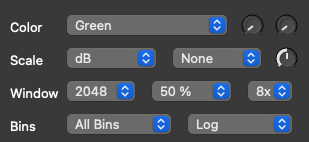
      <li>Change the following settings in the right-hand sidebar that appears with the spectrogram as follows (<a href="../assets/sv-settings.png">screenshot</a>):
        <ul>
          <li><strong>Window</strong>:    2048   50%   8x</li>
          <li><strong>Bins</strong>: All Bins   Log</li>
          <li>Other settings can be left unchanged.</li>
        </ul>
      </li>
    </ol>
  </li>
  <li>Add new layers with additional analysis.
    <ol>
      <li>Go to <strong>Transform &gt; Analysis by maker &gt; Matthias Mauch &gt; pYIN: smoothed pitch track</strong>; hit “OK” and just use the default settings. If needed, change the color of the plot to something that will stand out against the spectrogram.</li>
      <li>Go to <strong>Transform &gt; Analysis by maker &gt; libxtract &gt; A–S &gt; RMS Amplitude</strong>. Change the <strong>Window increment</strong> setting to 4096; hit “OK” to generate the analysis. On the bottom-right of the property boxes (the right sidebar), toggle off “Show”, so that the RMS amplitude graph is hidden instead of overlaid on the spectrogram.</li>
      <li>Go to <strong>Layer &gt; Add new time instants layer</strong>. Use this to add annotations to the spectrogram that orient us within the form, as follows:
        <ol>
          <li>Refer to the lyrics (uploaded on Teams). Every four lines or so, there is a double-space between lyrics. This indicates different sections of the song.</li>
          <li>For each new section, add a time instant by using the Draw tool. It may help to zoom in enough so that you can visually see where new sections start.</li>
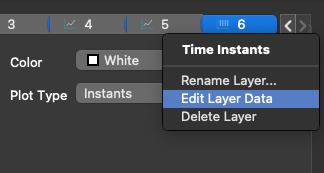
          <li>Once you’ve entered all the time instants, go to the property boxes (the right sidebar) and right-click on the tab for the Time Instants layer and select <strong>Edit layer data</strong> (<a href="../assets/edit-time-instants.png">screenshot</a>). In the popup window, replace “New Point” with the first word(s) of the lyrics in that section—enough to distinguish the sections and get you oriented.</li>
        </ol>
      </li>
    </ol>
  </li>
  <li>Finally, go to <strong>File &gt; Export image file</strong>. Enter a filename to upload to your homework folder (as a reminder please begin your filename with <code class="language-plaintext highlighter-rouge">9</code> (the current week number); after that I don’t care what the file name is). After you confirm your file name, another dialog box will appear; select the option to export the whole pane.</li>
  <li>Upload your PNG file to your homework submit folder.</li>
  <li>Save your Sonic Visualiser session by going to <strong>File &gt; Save session.</strong> Name it whatever you like and save it somewhere you will be able to easily locate it again. You will need this file to do your homework next week.</li>
</ol>

<hr />

<h2 id="week-10-mar-18">Week 10 (Mar 18)</h2>

<h3 id="reading-due-tue-mar-19">Reading due Tue, Mar 19</h3>

<p>Provenzano 2018, Malawey 2020</p>

<p>Discussion leaders: Stephen Gliatto, Rui Tang</p>

<h3 id="assignment-due-fri-mar-22">Assignment due Fri, Mar 22</h3>

<p>This homework assignment will continue to build on the Sonic Visualiser session you created last week, so begin by loading your Sonic Visualiser session. (If you lost your file, redo the assignment from last week…!)</p>

<p>Using Sonic Visualiser as an aid, create an analysis similar to Duguay’s Example 18. “MOVE” has two singers, whose vocals I’d like you to analyze separately: Beyoncé and Grace Jones. If you don’t already know how to distinguish their voices, just listen to a track by each of them—they are pretty different so I don’t think you’ll need much training.</p>

<ol>
  <li>Open your Sonic Visualiser session from last week.</li>
  <li>I have uploaded a template chart to Teams, titled <code class="language-plaintext highlighter-rouge">duguay-template.xlsx</code>. Download a copy of the chart (please do not edit the one on Teams) to record your analysis.</li>
  <li>Export both your Time Instants layer and your RMS Amplitude as CSV files by going to <strong>File &gt; Export annotation layer</strong>. Open both files.</li>
  <li>Create a row for each section of the song indicated in the lyrics file. Break out your analysis into these different sections. You might find it useful to use your Time Instants data for this.</li>
  <li>For <strong>width, environment, and layering</strong>, you will analyze through aural analysis (close listening) of the isolated vocals. The spectrogram may help you navigate the recording and attend to certain features, but there are no special tools in Sonic Visualiser to do the work for you.</li>
  <li>For <strong>pitch range</strong>, because Beyoncé and Grace Jones sometimes sing together, the Smoothed Pitch Track will not be totally accurate, but it is helpful.
    <ol>
      <li>Listen closely to the isolated vocal track while watching the spectrogram + Smoothed Pitch Track overlay.</li>
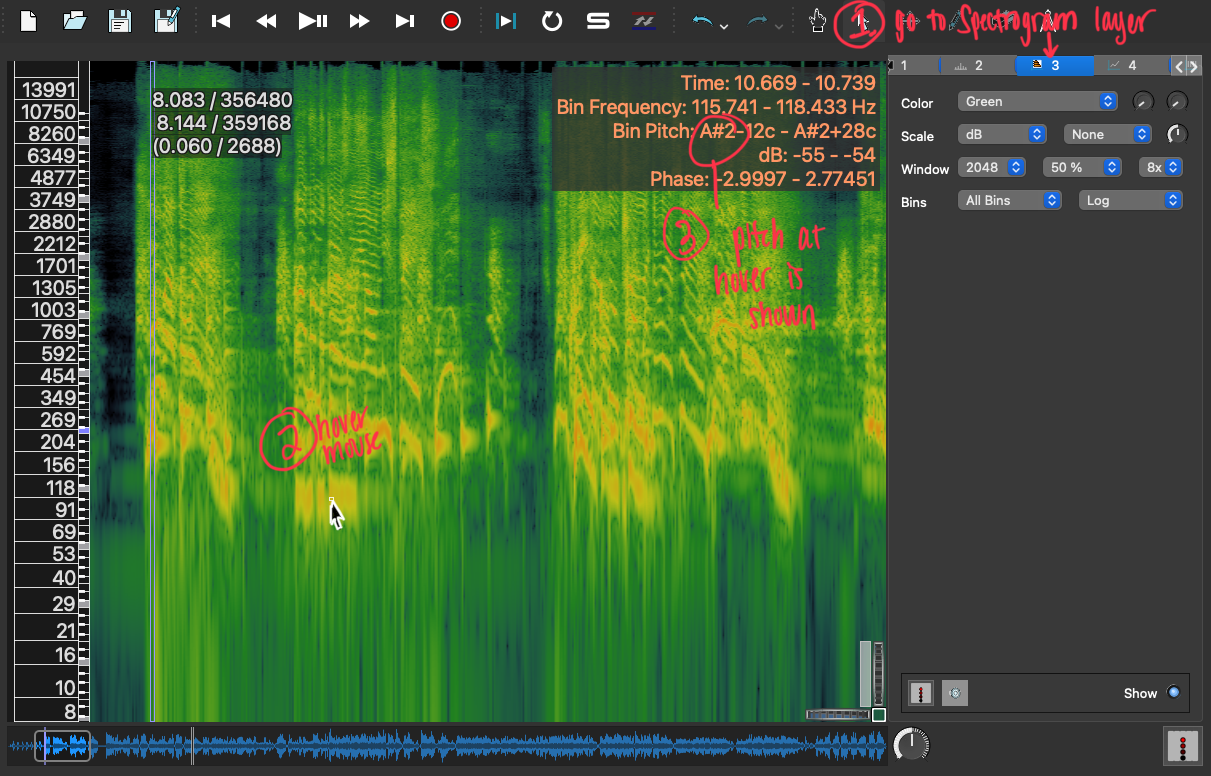
      <li>When it seems like the Smoothed Pitch Track missed the fundamental, temporarily hide it by toggling off the Show button in the bottom right of the property boxes; then, when you hover over the correct fundamental on the spectrogram, you should see a box pop up on the top right of the spectrogram that shows the frequency at the point your mouse is over (<a href="../assets/frequency-id.png">screenshot</a>).</li>
      <li>For each section, write down the highest and lowest pitch, separated by vocalist.</li>
    </ol>
  </li>
  <li>For <strong>prominence</strong>, you will have to export some data generated through Sonic Visualiser plugins and do some math with Excel.
    <ol>
      <li>Prominence needs data from the full audio track (not just the isolated vocals). Start a new Sonic Visualiser session and import the complete audio for “MOVE”.</li>
      <li>Go to <strong>Transform &gt; Analysis by maker &gt; libxtract &gt; A–S &gt; RMS Amplitude</strong>. Change the <strong>Window increment</strong> setting to 4096; hit “OK” to generate the analysis.</li>
      <li>Export the RMS Amplitude layer as you did last week. Make sure you title the file something distinct from the other RMS amplitude file you generated with the isolated vocals.</li>
      <li>In <code class="language-plaintext highlighter-rouge">duguay-template.xlsx</code>, open the second tab, titled <code class="language-plaintext highlighter-rouge">prominence calculation</code>.</li>
      <li>Paste the data from Time Instants into <strong>all three</strong> of the empty tables. Select those cells you just pasted, and change their background to yellow (this makes them easier to find in the next few steps).</li>
      <li>Paste the data from the <strong>isolated</strong> RMS Amplitude into the <strong>gray</strong> empty table, underneath the highlighted Time Instants cells, so that everything is in one table.</li>
      <li>Paste the data from the <strong>complete</strong> RMS Amplitude into the <strong>blue</strong> empty table, underneath the highlighted Time Instants cells, so that everything is in one table.</li>
      <li>In both tables, click the little arrow on the header cell titled <code class="language-plaintext highlighter-rouge">time (seconds)</code> and sort the data from smallest to largest. The highlighted cells with form labels will now be properly distributed through the column of data, dividing the data up into sections.</li>
      <li>To calculate the average RMS amplitude of a section, go into the corresponding cell in the <strong>yellow</strong> table and type <code class="language-plaintext highlighter-rouge">=average(</code> and then use your mouse to click and drag to select all the cells in a section.</li>
      <li>Finally, the last column in the <strong>yellow</strong> table will calculate the prominence according to the formula laid out by Duguay, using the formula <code class="language-plaintext highlighter-rouge">=([@[isolated avg]]/[@[complete avg]])*100</code>. This number is what you would enter in your summary table, on the other tab of the Excel sheet.</li>
      <li>Once you are (finally…) all done, go to <strong>File &gt; Export &gt; PDF</strong>. Whew!</li>
      <li>Write a tiny bit of interpretation of the Summary table you created. Use Duguay’s discussion of Example 18 as a model for your own analysis. You might compare how each singer is treated, how the vocal timbre is different in different sections, or something else. Just a couple sentences is plenty—I know you did a lot of work! Export this as a PDF too.</li>
      <li>Combine your two PDFs into one…</li>
      <li>Title your PDF with something beginning with <code class="language-plaintext highlighter-rouge">10</code> (the week number). Upload to your homework submit folder.</li>
    </ol>
  </li>
</ol>]]></content><author><name>Megan Lavengood</name></author><summary type="html"><![CDATA[The study of voice and vocal timbre has flourished immensely in the past couple of years.]]></summary></entry><entry><title type="html">Defining Timbre</title><link href="https://meganlavengood.github.io/2024/defining-timbre.html" rel="alternate" type="text/html" title="Defining Timbre" /><published>2024-01-11T15:10:11+00:00</published><updated>2024-01-11T15:10:11+00:00</updated><id>https://meganlavengood.github.io/2024/defining-timbre</id><content type="html" xml:base="https://meganlavengood.github.io/2024/defining-timbre.html"><![CDATA[<p>Timbre is a multifaceted concept that is approached differently in different fields of research. We’ll begin by examining the breadth of these definitions.</p>

<hr />

<h2 id="week-1-jan-15">Week 1 (Jan 15)</h2>

<p>On our first class, we’ll do some housekeeping—going through the syllabus, getting you acquainted with Teams and the course website, and introducing ourselves.</p>

<p>There won’t be any reading due before class.</p>

<h3 id="assignment-due-fri-jan-19">Assignment due Fri, Jan 19</h3>

<p><em>[Don’t forget to indicate which readings you want to discussion lead! <a href="https://gmuedu.sharepoint.com/:x:/s/Spring-2024-AnalysisofTimbre-GRP/EUNNtGkTFTFKlo9MAytpNowBBm66Wu2g529Gr2Ozn3fY1g?e=jbId0z">View all the readings here</a>, and <a href="https://forms.office.com/Pages/ResponsePage.aspx?id=VXKFnlffR0ygwAVGRgOAy-R6DEGoI95Pu0sh7qW5mvpURERPVzFLM0lIRUtUWDhRMlBYRFo0VjMyTS4u">submit your choices here</a>.]</em></p>

<p>In class, you’ll be assigned a partner and you will move into a breakout room with your partner. You and your partner will each give the other three timbral descriptors. Write down the descriptors you agreed upon. <a href="https://gmuedu.sharepoint.com/sites/Spring-2024-AnalysisofTimbre-GRP/_layouts/15/Doc.aspx?sourcedoc={5d1d3d40-6d56-4dd9-b350-4b1ed8695bf6}&amp;action=edit&amp;wd=target%28wk%201%20h.one%7Cff1cfed0-dd66-4c81-8c2e-d5bf303f8d2b%2FWeek%201%20hw%20timbre%20descriptors%7C3dac99f8-8bfc-4b32-93be-0f7c22fae312%2F%29&amp;wdorigin=703">We will record them in the class notebook</a>.</p>

<p>After class, create and record a sound for each descriptor your partner gave you. The sound you create should be emblematic of that descriptor. You can use any method to create the sound—record yourself playing your instrument, synthesize a new sound, manipulate an existing sound, etc. (This is a good time to remember that assignments are just graded on completion, so you don’t need to worry about correctness.)</p>

<p>Export your sounds as .mp3 files and name the files <code class="language-plaintext highlighter-rouge">lastname-descriptor.mp3</code>. For example, if I recorded a sound for the descriptor “smooshy,” I would name my file <code class="language-plaintext highlighter-rouge">lavengood-smooshy.mp3</code>.</p>

<p>Write up a short description of how you created the sounds. Save that description as a PDF and name the file <code class="language-plaintext highlighter-rouge">lastname.pdf</code>.</p>

<p><strong>Upload all three .mp3 files and your .pdf</strong> to your homework submit folder on Teams.</p>

<p>Some resources that might be helpful:</p>

<ul>
  <li><a href="https://www.audacityteam.org">Audacity</a>, a free app for recording and editing audio</li>
  <li><a href="https://www.websynths.com/microtonal/">Websynths Microtonal</a>, a web-based synthesizer</li>
  <li><a href="https://support.audacityteam.org/basics/recording-desktop-audio">How to record computer audio</a>
    <ul>
      <li>Apple computers with Silicon chips can use <a href="https://apps.apple.com/us/app/ladiocast/id411213048?mt=12">LadioCast</a> instead of Soundflower</li>
    </ul>
  </li>
</ul>

<hr />

<h2 id="week-2-jan-22">Week 2 (Jan 22)</h2>

<h3 id="reading-due-tue-jan-23">Reading due Tue, Jan 23</h3>

<p>Siedenberg and McAdams 2017</p>

<h3 id="assignment-due-fri-jan-26">Assignment due Fri, Jan 26</h3>

<p>This builds on last week’s activity.</p>

<p>I will copy the samples your partner recorded to a folder called <code class="language-plaintext highlighter-rouge">week 2 hw samples</code>. Listen to the sounds that your partner made for your descriptors.</p>

<p>Your homework this week is to write a response. For each sound sample, answer the following questions:</p>

<ol>
  <li>Do the sounds your partner created match what you imagined when you gave them the descriptor?</li>
  <li>What are the acoustic features of your partner’s sounds that correlate to the descriptor you gave?</li>
  <li>Come up with one additional term that could also describe the sample.</li>
</ol>

<p>Additionally, write a few sentences with your main takeaway on this activity.</p>

<p>All of this will probably take around 500 words, I estimate.</p>

<p>Save your response as a PDF and upload your homework submit folder on Teams.</p>

<hr />

<h2 id="week-3-jan-29">Week 3 (Jan 29)</h2>

<h3 id="reading-due-tue-jan-30">Reading due Tue, Jan 30</h3>

<p>Fales 2002, Eidsheim and Whelden 2019</p>

<p>Discussion leaders: Neal Wentz and Andrew Wood, Malcolm Taylor</p>

<h3 id="assignment-due-fri-feb-2">Assignment due Fri, Feb 2</h3>

<div class="border-box"> <p><b>Note on submitting (all weeks, not just this time)</b></p><ul><li>Please submit only PDF files unless I specifically request otherwise.</li><li>Please begin your filename with the week number. For example, this week, your filename should be <code>3 [whatever]</code> (I actually don't care about the rest of the filename).</li></ul></div>

<p>Write a reflection essay to this unit’s readings (that is, this week’s readings as well as last week’s). (Note: this should be a personal reflection or response, not a summary of the readings. There is no right or wrong answer. You could and should use first-person pronouns.) Some thoughts for you to consider:</p>

<ul>
  <li>Based on what we’ve read so far, what are the main problems in defining and analyzing timbre?</li>
  <li>What aspects of timbre research are you most interested to learn more about? For example, acoustic, perceptual, cultural, timbral details/microtimbre, essential instrumental timbres/macrotimbres, polyphonic timbre, something else…? Why does this interest you?</li>
  <li>What are some places where authors seem to agree or disagree?</li>
  <li>How has your perception of timbre changed based on these readings?</li>
</ul>]]></content><author><name>Megan Lavengood</name></author><summary type="html"><![CDATA[Timbre is a multifaceted concept that is approached differently in different fields of research. We’ll begin by examining the breadth of these definitions.]]></summary></entry><entry><title type="html">Orchestration</title><link href="https://meganlavengood.github.io/2024/orchestration.html" rel="alternate" type="text/html" title="Orchestration" /><published>2024-01-11T15:10:11+00:00</published><updated>2024-01-11T15:10:11+00:00</updated><id>https://meganlavengood.github.io/2024/orchestration</id><content type="html" xml:base="https://meganlavengood.github.io/2024/orchestration.html"><![CDATA[<p>Though technically distinct from timbre, orchestration is a closely related field of concern; most timbre scholars also study orchestration. These readings are some of the best for understanding orchestral music.</p>

<hr />

<h2 id="week-4-feb-5">Week 4 (Feb 5)</h2>

<h3 id="reading-due-tue-feb-6">Reading due Tue, Feb 6</h3>

<p>Dolan 2013, Rehding 2018</p>

<p>Discussion leaders: Sara Brannon, Judith Rautenberg</p>

<h3 id="assignment-due-fri-feb-9">Assignment due Fri, Feb 9</h3>

<p>In Files on Teams, go to the folder <code class="language-plaintext highlighter-rouge">Week 4 musicxml files</code>. There you will find several orchestral scores in MusicXML format. (I downloaded these from MuseScore and didn’t have time to rigorously investigate each of them, so be aware that there may be weirdnesses/mistakes in these scores. Nevertheless, I think this homework will be instructive!)</p>

<p>Go to <a href="http://orcheil.ca">Orcheil</a>, a tool developed to create orchestration visualizations like Dolan’s. Choose one of the orchestral pieces available in xml format, preferably one that you know well. Generate a visualization using Orcheil by uploading the musicxml file (note that it may take several minutes for the visualization to be created). Experiment with the settings regarding dynamics and register, and see which combination of settings yields the most instructive graph for you and your piece.</p>

<p>Take a screenshot (<a href="https://support.apple.com/guide/mac-help/take-a-screenshot-mh26782/mac">macOS</a>, <a href="https://www.microsoft.com/en-us/windows/learning-center/how-to-screenshot-windows-11">Windows</a>) of your favorite graph and add it to a document. Write 250–500 words analyzing the graph like Dolan might.</p>

<p>Save the document (writing + image) as a PDF and upload to your homework submit folder.</p>

<hr />

<h2 id="week-5-feb-12">Week 5 (Feb 12)</h2>

<h3 id="reading-due-tue-feb-13">Reading due Tue, Feb 13</h3>

<p>Wallmark 2019, Reymore 2021</p>

<p>Discussion leaders: Zijing Wang and Bolun Zhang, Clem Pearson</p>

<h3 id="assignment-due-fri-feb-16">Assignment due Fri, Feb 16</h3>

<p>Write ~500 words in which you compare the results of Wallmark’s and Reymore’s studies. Where do they align? Where do they diverge? And how do these studies reflect your own musical experience?</p>

<hr />

<h2 id="week-6-feb-19">Week 6 (Feb 19)</h2>

<h3 id="reading-due-tue-feb-20">Reading due Tue, Feb 20</h3>

<p>McAdams et al 2022</p>

<p>Discussion leader: Carrie Benkert</p>

<p>Note that the ACTOR project has a <a href="https://timbreandorchestration.org/tor/modules/taxonomy/orchestral-grouping-effects/introduction">helpful summary of examples</a> related to this article.</p>

<h3 id="assignment-due-fri-feb-23">Assignment due Fri, Feb 23</h3>

<p>Prepare for the analysis symposium (instructions below!)</p>

<hr />

<h2 id="week-7-feb-26-analysis-symposium">Week 7 (Feb 26): Analysis Symposium</h2>

<p>This week, we’ll have no new readings. Instead, everyone will collaborate on an analysis project. We will analyze one of my favorite orchestral pieces, <em>Rite of Spring</em> by Igor Stravinsky (1913). Materials are available on Teams in a folder titled <code class="language-plaintext highlighter-rouge">Analysis Symposium materials</code>.</p>

<p>I’ve selected two movements for us to focus on. I’d like groups to work together on the following movements:</p>

<ul>
  <li>Groups 1, 2, and 3: Introduction</li>
  <li>Groups 4 and 5: Spring Rounds</li>
</ul>

<p>You’ve each been assigned a group and put into a channel on Teams with your other group members. Please collaborate with one another on your analyses before our class discussion on Tuesday—share notes, bounce ideas off each other, etc.</p>

<div class="border-box">Note: This is much less structured than the analysis symposia I've run in Analytical Techniques (MUSI 611). I want to give you ideas but I don't have super-specific requirements or a grading rubric. Note that unlike in Analytical Techniques, this analysis symposium is not a separate part of your grade; I will count this as your homework and participation for week 7. </div>

<h2 id="expectations">Expectations</h2>

<p>The only broad requirement I have for you is that you somehow apply the methodology of one of our readings so far. I have more ideas about how that will work below.</p>

<p>I also encourage you to bring your particular expertise into the discussion (especially orchestral instrumentalists and conductors; less applicable probably for pianists and vocalists).</p>

<p>Please listen extensively to both movements and to the whole work. While your analytical focus should be on your assigned movement, you should know the whole piece well.</p>

<p><strong>By class time on Tuesday,</strong> please submit some kind of written work in your <code class="language-plaintext highlighter-rouge">homework submit</code> folder that represents your preparation for the discussion. Note that this is a different deadline than normal homework submissions. <strong>This will count as your homework submission for Week 7.</strong></p>

<p>In class on Tuesday, I hope we can have a robust discussion of what you all found and how you were able to use the readings to help you. I will be paying special attention to everyone’s participation in this week!</p>

<h2 id="how-you-might-apply-each-of-the-readings-so-far">How you might apply each of the readings so far</h2>

<p>I’ve ordered this from easiest to to implement (in my estimation).</p>

<ol>
  <li>McAdams et al 2022
    <ol>
      <li>Parse the score into auditory streams and annotate the score to show these streams</li>
      <li>Label the annotated streams with any orchestral grouping effects at play. I imagine that <strong>concurrent</strong> effects (blend or non-blend and its subcategories) will be most interesting, followed by segmental effects, then sequential. But follow your instincts.</li>
    </ol>
  </li>
  <li>Dolan 2013
    <ol>
      <li>Identify orchestral gestures Dolan defines through Haydn: <em>premier coup d’archet</em>, slow openings, use of solo/concertante writing versus orchestral tutti, thematic growth, thematic variation via orchestration, and anything else you’ve extracted from the reading.</li>
      <li>Use Orcheil to create a layer graph (or create your own from scratch, if you’re brave!).</li>
    </ol>
  </li>
  <li>Reymore 2022: Identify moments of surprising orchestral pairings or contrasts and use the Euclidean distance measurements and/or the timbral trait profiles to attempt to explain the contrast/pairing and why it is (or isn’t…? dare you criticize Stravinsky?) effective.</li>
  <li>Eidsheim and Whelden 2018: Research the cultural context for this piece, especially Stravinsky’s “primitivist” style and the riot at the piece’s premiere. (Please be sure to use scholarly sources; if you are unsure you can evaulate this properly, please don’t choose this activity). Imagine the experience of the premiere, and analyze the dissonance between listener expectations and what they were presented with at the premiere, in a way similar to the authors’ analysis of Bobby Caldwell.</li>
</ol>

<p>(You could engage the other readings too if you have a good idea of how that might work, but I personally am not immediately coming up with ideas…!)</p>]]></content><author><name>Megan Lavengood</name></author><summary type="html"><![CDATA[Though technically distinct from timbre, orchestration is a closely related field of concern; most timbre scholars also study orchestration. These readings are some of the best for understanding orchestral music.]]></summary></entry></feed>